
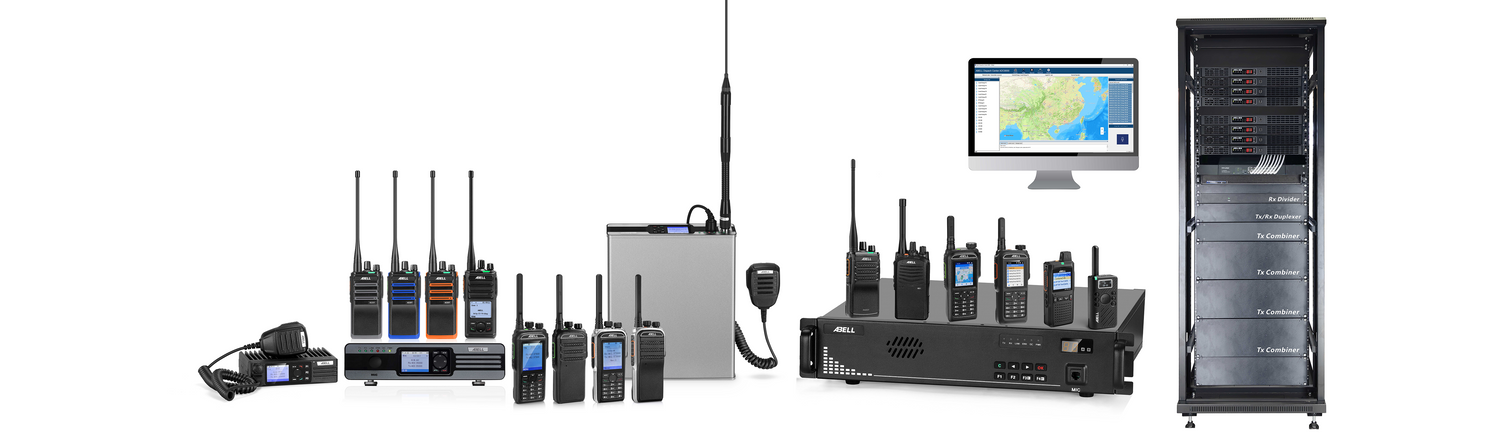
The IP-connected emergency command and dispatch system refers to a radio emergency command and communication network composed of multiple single-site relay systems connected through a standard IP network. It utilizes information technology and intelligent methods to conduct emergency command and dispatch work, ensuring radio services, facilitating emergency response and rescue efforts, and improving response speed during emergencies such as natural disasters and work safety accidents. It also enhances radio security for major events and the handling of emergencies.

Handheld walkie-talkie terminals and vehicle-mounted radios, leveraging IP base stations, can automatically roam across regions without geographical limitations, achieving uninterrupted voice and data communication. The system includes: a dispatch server, a network-wide recording server, switches, dispatch communication software, IP repeaters, digital base stations, digital walkie-talkies, and customized software as required by the client.
System Function
Find definitions for key terms and concepts
User Registration
User Registration
User registration enables the registration function within the system. Only handheld radios added to the registry can communicate within this system. Unregistered users are denied communication. After user registration, the system can manage various services of the handheld terminals.
Combined TCP/IP Protocol
Combined TCP/IP Protocol
The system uses a client/server architecture. Data transmission uses the TCP/IP network transmission protocol. The interconnected system can be built wherever there is an IP network. The system server can be built in LAN, WAN (static IP required), cloud, VPN, and other network environments to meet the needs of customers in different environments and achieve domestic and international interoperability.
Track Management
Track Management
Terminal devices support GPS, BeiDou, and other positioning methods. The location information of each terminal can be obtained in real time in the background. The data is displayed on the dispatch console map, allowing for dynamic trajectory queries of designated terminals via the dispatch console.
Example: Supports Positioning, Track Playback, Map Display, and Visual Dispatch
Calling Methods
Calling Methods
Supports group calls, all calls, and broadcast calls The system supports group calls, all calls, and broadcast voice call functions;
Visualized RDAC
Visualized RDAC
Visualized RDAC diagnostic and control software supports fault diagnosis and fault alarm functions for interconnected trunk equipment, and supports displaying power on/off logs and alarm logs;
Example: Upon connecting to the interconnected system's trunk equipment, fault diagnosis and fault alarm functions are enabled. Fault diagnosis and alarm functions include: RF power amplifier, exciter, receiver, control board, and other module diagnostics, real-time monitoring of equipment operating status, and providing safe and effective protection for system hardware;
Remote Writing
Remote Writing
Supports remote frequency programming of interconnected trunks, Remote trunk frequency programming function Yes, it allows users to remotely modify repeater programming parameters, providing programming support for repeater deployments in remote and hard-to-reach locations, such as forest areas and mines;
Remote Alarm
Remote Alarm
In emergencies, it enables one-click alarm and network-connected alarms. While issuing an alarm locally, it can also send the alarm signal to the network dispatch console, allowing users to better request assistance in critical moments;
Call Status Alerts
Call Status Alerts
The dispatch software allows users to monitor the call status of members in their group in real time, displaying it on the dispatch console;
Recording Management
Recording Management
The recording function saves recording data on all handheld terminals within the system, and the number of recordings... Recordings are decoded and played back within the dispatch software;
Hierarchical management
Hierarchical management
Hierarchical management of dispatch console groups/users and terminal call priority management are implemented;
Example: Convenient dispatch operations and hierarchical management of groups/users allow real-time viewing of which users belong to which groups;
Network topology display
Network topology display
The network topology display function shows which relay devices are currently connected to the system, their online/offline status, and allows users to intuitively understand the current system network structure within the dispatch console and RDAC diagnostic and control software;
C/S architecture
C/S architecture
C/S architecture enables unified allocation of network devices. Unified Management: This system provides unified storage for voice, location, and log data.
Example: Its architecture is client/server (C/S), facilitating centralized data management and ensuring the security of various business data.
Digital IP Group Management
Digital IP Group Management
The digital IP group management function allows trunks within the system to connect directly according to user needs. Trunks can only communicate within the same digital IP group. Digital IP groups allow for dual-timeslot settings on trunks; one trunk can be configured with two groups across time slots.
Remote Activation/Deactivation:
Remote Activation/Deactivation:
System administrators can remotely activate/deactivate specific terminal users. For more refined user management
Short Message Service
Short Message Service
The ADC8000 can send and receive SMS messages from other terminals;
ADC8000 Dispatch Software
ADC8000 Dispatch Software
Implements dispatch agent functions, including group calls and broadcast calls;
Example: The dispatch software implements dispatch agent functions, enabling group calls and broadcast calls, making the dispatch software more operable and practical;
Authorization Function
Authorization Function
The authorization function authorizes trunk stations and handheld terminals to enable advanced functions, such as authentication. Authentication can only be enabled after user authorization. Trunk stations and handheld terminals without authorization do not have authentication functionality
Roaming
Roaming
The roaming function allows handheld terminals to switch between trunk stations based on signal strength, addressing users' cross-regional communication needs;
Schematic diagram of multi-base station scheduling system


